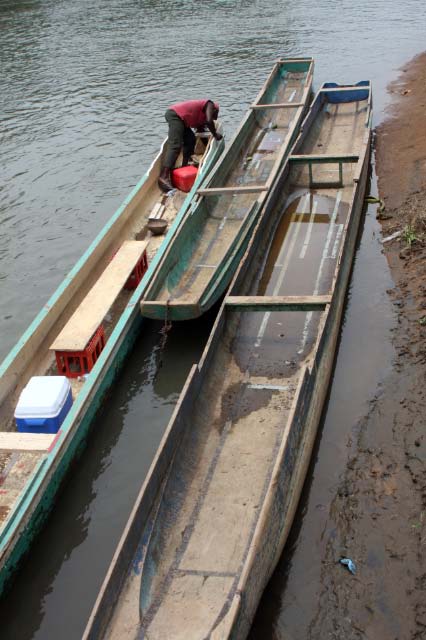
In 2010, starting from the small town of Yaviza in the Darién Gap of Panama, I traveled by piragua up the Río Chico, to three remote Chocó villages, a journey allowed to few outsiders. A family member with Darién connections got me there, and I went just in time. Several months later, Panama prohibited travel by almost all outsiders beyond Yaviza due to its increased military operations against Colombian FARC guerrillas. When travel is again allowed, outsiders may no longer see Chocó women in traditional attire in the villages we visited, for modernity is coming fast to the Darién.
My niece's husband Edi arranged the trip. He had family roots in the Darién. He grew up in Panama City but had spent part of his youth on his family farm in the Darién. His surname was from a Greek forebear who immigrated to the Darién. His earlier Darién ancestors were Cimarrones, escaped black slaves who often joined the English to fight the hated Spanish. Edi's great-grandfather played a key role in establishing the Darién as a province following Panama's independence from Colombia. His late father was a physician who represented Darién Province in the Panama legislature. Edi knew people who could grant us permission to travel beyond Yaviza, and who could get us a piragua to go up the Río Chico.
The family farm was near the small Darién town of Santa Fe. When we made our trip, the paved road connecting Panama City with Yaviza was but a few years old. In Edi's childhood during the 1980s and 1990s, the road was dirt, access was difficult, and modernity had not yet arrived. Edi commonly saw Chocó women in traditional attire, meaning they wore only a skirt. The paved road brought modernity and outsiders, and the women in their modesty donned tops, at least when outsiders were present. By 2010, one had to travel upriver to remote villages to see the traditional ways, but even that was quickly changing. Modernity was making
inroads and more women were dressing accordingly.
I'm not the first in my family to travel to the Darién. In the early 1960s, a first cousin once removed spent several weeks living with the Chocó. He served in the US Army Topographic Command and was on a team mapping the Darién for a possible second Panama Canal. His team hired the Chocó as guides. On my visit with him in 1981, he showed me his slides of the trip. The Chocó men wore loincloths. Some had college degrees - they represented their tribe in legal dealings with the Panamanian government.
The Darién is still a remote area. Parts have yet to be mapped. The USA Defense Mapping Agency's 1995 1:100,000 Darién topographical map (based in part I'm sure on the work my relative's team) is the most accurate and up-to-date map. I secured my copy from the Instituto Geográfico Nacional "Tommy Guardia" at the University of Panama a few days following our trip. There are sections of the map (not where we traveled) marked "Datos insuficientes" and "Limites de información confiable de relieve." People have lived in the Darién for ages but cartographers have not fully poked around.
The Drive from Panama City to Yaviza, April 13, 2010
My wife and I were staying at my sister-in-law's house in the neighborhood of Río Abajo outside of Panama City. Edi arrived at 9:40 AM. I loaded my bags and kissed my wife goodbye, and Edi and I were on our way.
Not too many years ago the concrete highway ended east of Panama City ending at Tocumen, where Panama's main airport was located. Beyond that was a gravel road, open year round, that ended in Cañita. Back then the road to Yaviza was a very rough, requiring an all-terrain vehicle, and the traveler passed through jungle and traditional villages.
With the paved road linking Panama City with Yaviza, the journey now takes but a few hours. The jungle alongside the road has been cut down and converted to range land for cattle. Deforestation continues in the hills and mountains. Trucks filled with large logs pass by, while distant plumes of white smoke mean more jungle is being cleared by the slash and burn method. This destruction of the jungle is a tragedy.
Entering Darién Province at Las Aguas Frías we encountered the first Senafront checkpoint of our journey. Senafront is the acronym for El Servicio Nacional de Fronteras. This is Panama's border police. Panama technically has no military, its Guardia Nacional disbanded following the United States Operation Just Cause invasion. But Senafront operates as a military service, with the United States providing some funding and training.
A troop motioned us to pull over and stop. We walked to the small concrete checkpoint building and provided another troop our identification, Edi his cedula and me my passport. He asked our destination and purpose of our travel. Edi said we were headed to Yaviza to visit his family friend. The troop wrote our information in a log. I asked permission to take his photograph, which he gave.
Our next stop was Edi's family farm, directly off the highway between Santa Fe and Punulosa. Edi said the farm's boundaries extended from the highway to the mountains several miles to the south. Vandals destroyed the modest concrete block house following his father's death. The family later built a small wooden house, now occupied by a caretaker. Edi complained that the caretaker was remiss in watching the property. The caretaker was nowhere about this day. The family grew plantain and yucca, but much of the land was untended.
Metetí had the next Senafront checkpoint. It also had the primary Senafront base in the Darién. Edi said US military advisors were rumored to work at this base. A troop motioned us to pull over and stop. We presented our identification to the troop at the checkpoint building. I was able to take photos.
We stopped in Metetí for an overdue lunch. The small Restaurante Kelly was owned by a Chinese man. There was no printed menu, and we foolishly did not ask for the price before ordering our one-half fried chicken, patacones (fried plantain), and sodas. The tab was fifteen dollars. (Panama's Balboa is on par with the US Dollar, and Panama uses United States paper currency.) This was less than the cost of a similar meal in the United States, but an outrageous sum for these parts. Edi commented on the unscrupulous business practices of the Chinese. The two waitresses were Emberá and they wore the colorful skirts typical of the Chocó. One waitress allowed me to take her photograph.

The Chocó, extending from Panama to Colombia, are subdivided between the Emberá and the Wounaan. They share a culture but have different languages. One may ask a Chocó whether he or she is Emberá or Wounaan, and the answer is happily given. However, having learned this, one makes a faux pas if later mixing the distinction.
Leaving Metetí, Edi telephoned the alcalde of Darién Province to confirm that we still had permission to travel beyond Yaviza. She said we did.
We were now on the final leg of our journey east. Farms gave way to jungle. The road needed more maintenance. Soon we reached the outskirts of Yaviza. The road changed from asphalt to concrete, and it narrowed and became lined with buildings. More and more people walked about. Edi had to slow down. Salsa music blared from a speaker here and another over there. Edi asked some locals where we could find the house of our host. We were told to continue straight ahead. We crawled along. The road stopped at the intersection of a narrow concrete street. No sign announced it, but this was the southern end of the northern half of the Pan-American Highway. One could get into a vehicle in Prudhoe Bay, Alaska, and drive south, and the trip stopped right here. Panama had chosen to not extend the highway to Colombia, some thirty miles away, citing such things as preventing the spread of hoof-and-mouth disease, but really it did not want easier access for FARC guerrillas.
We turned left and drove down the narrow concrete street a short distance to the house of our host. He had been a good friend of Edi's father, and he and Edi's mother still kept in touch. This was Edi's first visit to Yaviza, hence the need to ask directions.
The Profesor, as Edi and I respectfully called our host, was eighty years old and in fine physical and mental shape. He had a cheerful disposition. He was a retired teacher and school administrator, hence his title. He was a widower whose children lived in Panama City. Being a prominent member of Yaviza, a town in which he had lived for sixty years, he had an active social life. People on the streets stopped to talk with him. His house was the finest in town. "Estilo Americano," he remarked to us about its construction. He built the two-story structure in 1965, living with his family upstairs and running the downstairs as a hotel to supplement his income. It had several rooms and a small restaurant with a bar. The building materials were brought upriver from the provincial capital of La Palma. Years ago he closed the restaurant and he now rented the rooms to school teachers.

The Profesor's house was some forty yards from the Río Chucunaque. Between his house and the river were the stone ruins of Fuerte San Jeronimo, built by the Spanish in the 1700s as part of a network of forts to protect gold shipments from nearby mines from English and Indian attack. The river had eroded the bank over the years, causing some walls to fall into the river. An interpretive sign in Spanish and English told the history of the fort.
After visiting with the Profesor a bit, Edi and I took leave for a short walk through Yaviza. The Profesor went to arrange our piragua for the next day's journey. We crossed the footbridge over the river. I noticed that the black citizens tended to live in the main town while the Indians tended to live across the river. (The Profesor was black.) Black and Indian children played together on both sides of the river. We walked through the neighborhood and watched the people going about their daily lives. The houses were built on stilts to protect from flooding, and were of wood construction with tin roofs. It was getting dark.
We came to the small community hospital and went inside. There were no locked doors or guards, the building was wide open. Some rooms had patients but generally we walked through empty corridors. The shelves behind the counter of the unattended pharmacy were filled with drugs. Theft seemed not to be an issue here. A large Chocó basket sat atop a filing cabinet in an office. The fluorescent bulbs on the hallway ceilings attracted insects coming in through open doors and windows. Small lizards seeking these insects scurried along the drab painted walls. There was no air conditioning. The evening was warm and humid.

We returned to the Profesor's house to find him on the upstairs balcony talking with Alejandro, the piragua owner who would take us up the Río Chico the next day. The cost would be sixty dollars. I shook Alejandro's hand to conclude the deal. We then sat and talked. There was cold beer in the ice chest. Alejandro abstained from the Cerveza Balboa but did stay for some thirty minutes. The Profesor and Edi and I continued the conversation for some time after that, sitting around the small table under the single incandescent bulb, enjoying the gentle breeze on that tropical evening, while nearby in the darkness the Río Chucunaque silently flowed along. The Profesor discussed the history of Panama and the Darién. I think I impressed him when with my imperfect Spanish I talked of Pedrarias' cruelty in ordering the beheading of Balboa.
We retired to the living room at 10:30 PM. The Profesor had a television satellite dish mounted on his roof, and he sat down to watch the news on CNN Español. Edi called his wife on his cell phone. I excused myself and went to my room. I checked my camera and video gear. Outside the room was a balcony overlooking the street and many tin rooftops. I surveyed Yaviza from this vantage point. Some kids were kicking a soccer ball in the street below me. Panamanian music blared from a nearby bar. The sweat on my face was sticky. I stank. I returned to my room and closed the screen door to the balcony. I washed down my first malaria pill with the last of my warm beer. I removed my shoes and lay down on the bed fully clothed. Sleep came easily despite the music blaring away.
Travel Up the Río Chico by Piragua, April 14, 2010
I awoke around five o'clock but stayed in bed as the Profesor and Edi were not yet up. We were up and about by six o'clock. From the balcony I took in the morning view of Yaviza. All was quiet save for the clucking of some chickens poking about the street below me, and the squawking of three large parrots kept as pets in the neighboring house.
We went to get breakfast. People were out and about. Children in their school uniforms walked to their classes. Shopkeepers were opening up. We took a table in the patio of a small restaurant. Edi cautioned me not to drink from the glass of tap water set before me. Breakfast consisted of a stewed chicken leg, a thick deep-fried tortilla, and coffee. The corn meal tortilla was almost tasteless and very tough to chew.
A large Senafront wanted poster was nailed to a tree by the restaurant. It pictured four FARC guerrillas, stating a reward of up to $200,000 for information leading to their arrest.
The following October, Gilberto Torres, pictured at left on the poster, along with four other FARC guerrillas, was killed by the Colombian military near the Panama border.
The US State Department's website provided this warning about the Darién:
SAFETY AND SECURITY: U.S. citizens are warned not to travel to remote areas of the Darién Province off of the Pan American Highway. Embassy personnel are only allowed to travel to the restricted border areas of the Darién and San Blas Provinces on official business and with prior approval of the Embassy’s Regional Security Officer and Deputy Chief of Mission. This restricted area encompasses the Darién National Park as well as some privately owned nature reserves and tourist resorts. The general remoteness of the region contributes to the potential hazards. Due to scarcity of roads, most travel is by river or by foot path. This combined with spotty medical infrastructure outside of major towns makes travel there potentially hazardous. While the number of actual incidents remains low, U.S. citizens, other foreign nationals and Panamanian citizens are potentially at risk of violent crime, kidnapping and murder in this general area. Moreover, all around the Panama-Colombia border area the presence of Colombian terrorist groups, drug traffickers and other criminals is common, increasing the danger to travelers. The Revolutionary Armed Forces of Colombia (FARC) operates in Panama’s Darién Province, including in areas far removed from the immediate vicinity of the Panamanian-Colombian border. Note: The Secretary of State has designated the FARC, the National Liberation Army (ELN) and the United Self-Defense Forces of Colombia (AUC) as Foreign Terrorist Organizations.
Less than three months before our journey, on January 27, Senafront troops opened fire on seven FARC guerrillas coming down the Río Tuira in a piragua. This was a little over ten miles east of Yaviza. They killed three guerrillas, wounded one, and captured two unhurt. The seventh guerrilla escaped. The guerrillas had entered Panama seeking food and supplies.
The Río Tuira was the main travel route from Colombia and was to be avoided by outsiders. The Río Chico was out of the way and hence we deemed it safe to travel.
Breakfast completed, the Profesor went off in search of Alejandro, giving Edi and me some time to walk around. We crossed the footbridge over the Río Chucunaque, turned left, and walked among the houses. The barking of a small dog interrupted the quiet of the morning. We followed the barking and learned the cause of the commotion. The dog was barking at a black-headed spider monkey on the front porch of a house. This was a wild monkey, attracted by the homeowner's offer of bananas. The monkey showed no visible fear of man so I think this was not its first visit. The porch was above us, as the house rested on stilts in this flood-prone area. The monkey walked about the porch rail as if it owned the place. It entered the house through the open front door, the homeowner following it. Both emerged about a minute later. The dog barked the entire time. Finally, the monkey made its way down the stilts to the ground, passing close by me as I took a video. It sauntered along a dirt path by the river's edge and disappeared around a corner.


We returned to the main town to find Alejandro at the muddy launch loading our gear into his piragua. The Profesor was with him. Alejandro then left to get breakfast. A piragua is a canoe made from a single hollowed-out tree trunk. In times past, long poles and muscles moved piraguas about the shallow rivers of the Darién, but now outboard motors provided the power. There were several other piraguas at the launch, their owners loading food and supplies into them, while passengers (mostly Chocoes) waited to board. With no roads beyond Yaviza, the rivers were the highways and piraguas were the mode of transport. Alejandro's piragua had two seats, one in front and one in back, with the center empty to allow maximum cargo storage space. For this trip, Alejandro made seats for Edi and me by placing a long 1x12 inch pine board atop two plastic milk crates. This made for an uncomfortable ride. Our gear was stored about. Critical for the journey was the cooler filled with ice and Cerveza Balboa. Alejandro returned and we boarded the piragua. The Profesor took the front seat, followed by me and then Edi on the pine boards, with Alejandro in the back seat to operate the motor. We shoved away from the bank. We hunched down to keep a low center of gravity for stability. This was the rainy season but we would be blessed with a completely dry day. The time was eight-thirty.
The Río Chico enters the Río Chucunaque about one-quarter mile upriver of Yaviza. We would go about seven miles up the Río Chico, into the indigenous lands of the Comarca Emberá-Wounaan, visiting three villages, the last one being about eighteen miles from the Colombian border.
Our journey up the Río Chico was far from solitary. We passed many Yaviza-bound piraguas laden with passengers and an assortment of items - bananas, plantains, and rice for trade, and empty propane tanks. A few faster piraguas going upstream passed us. Parts of the river were shallow and Alejandro had to maneuver to avoid hitting bottom. The Professor in front helped by pointing to the deeper waters. Riffles in the waters ahead warned of submerged trees. Alejandro had to stay alert.

We passed sections of thick jungle, followed by fields tended for rice and plantains, and an occasional house on a bluff. These were indigenous houses, built on stilts, the walls of sawn boards, and with thatched roofs. The Comarca is similar to a reservation in the United States. We were subject to tribal laws and could be asked to leave at any time and for any reason. But Edi's family was good friends of the Profesor, and the Profesor was a respected member of Yaviza and well known in the villages along the Río Chico.
I saw little wildlife. No caimans or turtles. There was a lizard that when alarmed at our approach would run atop the water a few feet, going from a fallen tree to the shore. There were butterflies with wings of an incredible iridescent blue.
While the piragua was in motion the breeze kept us comfortable, but when we stopped, the heat and humidity became oppressive. Not to worry, the ice chest had cold Cerveza Balboa.
Our first stop was the village of Común, UTM coordinates 18N211386 0905668. Alejandro guided the piragua to a gravel bank. As with the other two villages we would visit, Común was laid out in something of a grid pattern with concrete walkways. It had electricity and a small water system. Few people were about. There were some men talking outside the small tienda, a woman doing chores outside her house, and a few small children playing. The Profesor led us to the one-room school. He opened the door and poked his head inside. The teacher paused studies to step outside and talk. He and the Profesor knew each other. The teacher was Panamanian and his students were Indian.


Students in grades one to six attended school in their villages, while those in grades seven to twelve went to Yaviza for their education. Students in Común as elsewhere wore the Panama school uniform. Their older siblings attending school in Yaviza had cell phones and went to the community Internet café (fifty cents an hour).
We returned to the piragua and continued upriver. I got my first glimpse of the traditional ways when we passed an older woman bathing topless in the river. She paid no attention to us, ours was just another piragua on the river.
We soon reached the landing for the second village, Naranjal, UTM coordinates 18N213067 0907161. Two men and two women were bathing in the river at the landing. They were in their sixties, the women in skirts and the men in shorts.
My digital camera and video camera stayed at my side. Here as elsewhere, taking a picture of someone without their permission would be incredibly rude. But with conditions right and permission respectfully secured, people would gladly have their picture taken.
Walking along the dirt pathway to the village, we were met by a middle-aged man who identified himself as the cacique. He knew the Profesor and Alejandro, but asked the Profesor who Edi and I were and the intentions of our visit. The Profesor explained, adding that I had a knowledge of Panama and its history. This seemed to satisfy the man and he allowed us to proceed.
We walked to the elementary school where the Panamanian teacher was gathering her Indian students for their lunch break. The Profesor and the teacher spoke while I showed the students my video camera. I flipped the display around so they could watch themselves as I took their video. Here I got my favorite video of the entire trip, capturing the reactions of the children to the video display of themselves and their friends. But enough time on this, the teacher had to get the students to lunch. She walked them to the community dining hall. I took one last look at the school. A display board had posters explaining the meaning of Semana Santa (Easter Week). Panama includes the Catholic faith in its school curriculum.
As we followed the group downhill, one boy pointed out to me a small building we were passing. Inside it was a shrine with a statue of a Catholic saint revered by the locals. The boy wanted me to take a photograph of the shrine, which I did. We continued on. We passed a house outside which an older woman in traditional dress was hanging laundry.
We reached the dining hall and the students went inside. A man arrived with a large aluminum cooking pot containing the lunch meal. Then came the self-described cacique. He and the teacher spoke for a minute or two, and he walked away. The teacher told us that the man was now objecting to our presence in the village. She laughed and said she could overrule him on any visitors. This may or may not have been true, but in any case we were on our way to the piragua. We said goodbye to the teacher.
It was a short ride to the third and final village of the day, Corozal, UTM 18N213934 0907325. Here we would get our warmest greeting, spend the most time, and I would leave with my best memories.
A few Emberá children were playing at the river's edge when we arrived. We secured the piragua at the landing and ascended the concrete steps to the top of the bluff. We took the concrete walkway into the village. My video camera recorded the approach of an Emberá man. He wore shorts and flip-flops and a blue tee shirt, but what drew my attention to him was the AK-47 rifle slung across his back. He identified himself as a member of the local militia and asked the purpose of our visit. The Profesor explained. He told us to check in at the military compound a short distance away, adding that we were not allowed to travel further upriver. Corozal had the last Senafront outpost before the Colombian border. Senafront could not protect us beyond here.
The Senafront outpost was on the outskirts of the village. We arrived to find three soldiers sitting around a small table at the porch outside the entry. Panamanian music blared from a small radio inside the compound. The Profesor introduced Edi and me. The Profesor and Alejandro did not need to check in, for they were known here, but the soldiers asked Edi and me for our identification. Edi provided his cedula and I my passport. A soldier wrote our information into a booklet. The Profesor and Edi chatted with the soldiers. Edi explained that I was married to his wife's aunt.
The compound was built to withstand a FARC guerrilla attack. There were loaded Russian PKM machine guns mounted behind sand bags atop low walls and pointed out to the jungle. AK-47s were propped along the walls. Belts of machine gun ammunition hung from the walls. There were cots and hammocks with personal belongings and issued equipment. The compound had a dirt floor and a thatch roof. The walls were about four feet high and made of thick logs.
The soldier logging our information returned our identification. The Profesor and Alejandro and Edi and I then walked to the central part of Corozal, to a small tienda and restaurant run by an Emberá couple. We took shelter from the sun under the thatched roof of a bohio in front of the restaurant. There were some benches under the bohio, and the woman owner of the restaurant brought out some plastic chairs. The Profesor was known in this village and he talked with the Emberá couple and with others who chanced by.
An Emberá man stopped by to talk with the Profesor. I shook his hand and said hello. He left us, and about five minutes later returned with a bunch of overripe bananas for me. This was a gift, for which I thanked him. Edi gave me a cardboard box in which to put the bananas. He then returned to his house, about thirty yards from the bohio.
Edi told me that the man's wife made baskets for sale. One of my goals on this trip was to buy baskets from a Chocó woman who made them. We walked to their house.

The house was of traditional Emberá design. It was built on stilts to give protection not only from floods but also from critters that walked about at night. The living area was some eight feet off the ground. The couple looked down to us and invited us to enter. The wife wore only a colorful skirt while the husband wore shorts and a tie-dyed shirt. Access was by a thick log with notches for our footing. Edi went up first as I took a video. Then I climbed up. I said hello to the wife as I entered her house. Some floor sections were made of split white cane, sturdy enough for an Emberá, but I weighed a bit more than the locals, so I stayed on the sections made of sawn boards. The couple asked us to sit. They were in their fifties. I asked permission to take photos and videos, which they granted. The wife showed us some large baskets she was working on. A US military-issue aluminum canteen cup sat on the floor next to her. I wondered when was the last time a US military advisor had been in Corozal. Edi asked our hosts if they were Emberá or Wounaan. The husband emphasized that they were Emberá. The wife said she had three completed baskets for sale, two small ones for ten dollars apiece, and a larger one for fifteen dollars. The prices were similar to those in the tourist shops of Panama City, but I would be buying these from the woman who made them. The wife talked about the plants and dyes used to make the baskets. She said a basket took her a month to complete. I doubt her output was twelve baskets a year, I think she worked on several baskets combined during her limited spare time, taking a month to complete a single basket. Save for the modern needles, she made them the same way they have been made for centuries. With modernity arriving, I wonder how many girls in these villages will continue the basket making tradition. I bought the two small baskets, handing the wife a US twenty dollar bill. She put the baskets into a small plastic bag. Edi and I spoke with the couple a bit longer, and then we said goodbye, climbing down the notched log and returning to the bohio.
We then had lunch. The Emberá couple running the restaurant brought out plates of boiled beef (a bit tough), fried plantain, and fried yucca. I've had yucca in soups, but this was my first time eating fried yucca. I found it to be far better than French fries. We washed the food down with ice cold Cerveza Balboa. I paid for our four meals, a total of $10.48, and although tipping was unheard of here, I gave the woman twelve dollars.
Now filled with that satisfying lunch, and having downed another beer, I told Edi that I was interested in the large basket that I was offered. He and I returned to the couple's house and I bought the basket.
We returned to the bohio and sat in the shade and visited some more. The Emberá children laughed as I showed them the video photos I took of them.
We then followed the woman restaurant owner to a small plot of land where the Profesor raised various crops. We passed the military outpost and briefly spoke with the troops. Edi and the Profesor gathered some food items at the plot to take back to Yaviza.
It was now time to leave Corozal. We walked through the village to the landing. Alejandro already had the piragua loaded. Children were washing clothes in the river. We descended the concrete steps and boarded the piragua. Alejandro started the outboard motor and we shoved off. The restaurant owners and a few others stood atop the bluff and waved goodbye to us as we departed downriver.
Near Naranjal, we passed a young woman bathing topless in the river, the first young woman I had so seen. Past El Común, we stopped to pick up a man standing on the bank in need of a ride to Yaviza. We reached the Río Chucunaque and passed the ruins of the Spanish fort. Alejandro maneuvered the piragua to the muddy bank, and in moments we were standing on the shore, our journey ended.
Edi and the Profesor and I gathered our gear and walked to the Profesor's house. Alejandro met us a short time later with some of the foodstuffs gathered at the Profesor's plot in Corozal. I thanked Alejandro for taking us up the river, and gave him a ten dollar tip.
Edi and I left Yaviza at six-thirty the next morning, thanking the Profesor for his hospitality.
Post Script
Edi and I returned to Yaviza in 2012. Travel by outsiders beyond Yaviza was now essentially prohibited. Panama and Colombia were stepping up military operations against FARC guerrillas in the Darién. Security was tightened. We passed through not two but five Senafront checkpoints to reach Yaviza, providing our identification at each. The Senafront troops at the checkpoints did not smile. My requests for photos at the first two checkpoints were denied and after that I did not bother asking. While we walked in the main part of Yaviza, Senafront troops asked Edi and me what we were doing in town. On the morning of the second day of our visit, I was by myself at the San Jeronimo ruins and watched as three piraguas headed downriver passed by, each full of military gear and armed Senafront troops. I took a video of this but did not want to be seen doing so.
The government had built a new concrete launch for the piraguas. No need now to get one's shoes muddy when boarding a piragua. There was a lot of commerce on the river.
The wanted poster for FARC guerrillas was still nailed to the tree by the restaurant, only it was heavily faded from the sun.
The monkey that had freely roamed about two years earlier had been captured and was now confined to a small wooden cage. This cage was outside a house uphill from the house where we had first seen the monkey. I found this captivity to be incredibly cruel.
The US government had provided funds to upgrade the community hospital. A large sign outside the hospital announced this. But no longer could the casual visitor simply enter and walk around. A Senafront troop at the entrance barred Edi and me from going in. The troop told us that US military medical personnel came in from time to time to provide medical care to the citizens. This I'm sure was done in part to pursuade those in remote villages (who went to Yaviza for medical care) to not support FARC guerrillas.
Perhaps Edi and I in a few years will make another trip to Yaviza. By then the Profesor will likely be gone. We'll have to find other accommodations, nothing as good as the Profesor's rooms. The tap water will still be questionable, the beer will still be cold, and music will still blare from the speakers. Perhaps by then Panama and Colombia will have ended the FARC problem, and Panama will again allow travel by outsiders beyond Yaviza. But by then, at least up the Río Chico, modernity will likely have set in, and the outsider will no longer see the traditional ways. I'm glad I got to go up that river when I did.