At the end of our vacation, the aircraft taking us from Texas to California included the body of a soldier, escorted by his friend and comrade, a fellow soldier from his unit.
The escort was in service dress uniform. When I first saw him at the gate, I thought he was a recruiter. Three civilian volunteers wearing orange vests with the words Honor Escort soon arrived. I then thought a wounded soldier would be getting off the plane we would board.
But no wounded soldier departed the plane. Shortly before our boarding commenced, the airline attendant at the gate got on the public address, and announced that our flight would carry the body of a soldier from Fort Hood who died on active duty. The soldier escorting his comrade would go to the ramp to witness the placement of the casket into the aircraft. We were asked to stand in silence while this procedure was performed. We could look out the windows to the ramp below.
All the waiting passengers stopped talking and stood up and looked out the windows. The escort met the airline employees, who removed the flag draped casket from a trailer. The soldier escort saluted. Those airline employees not handling the casket or the flag saluted. The flag was lifted off the casket, and the casket was placed into the aircraft. The employees folded the flag with proper ceremony.
During this whole procedure, the waiting passengers remained standing. They did not move around, and they were completely silent. I doubt I was the only one with tears in my eyes.
The casket now aboard, the escort boarded first, taking a front row aisle seat, so he could be the first off the plane.
As we made our approach to Sacramento, the flight attendant got on the public address and asked us to remain seated upon reaching the gate, until the military escort left the plane. An Army honor guard awaited us at the ramp. All passengers remained seated and were quiet. From my seat I watched preparations for the removal of the casket. Once the escort left the plane, the passengers quietly got out of their seats and gathered their belongings. There was no rush to get out. There were no cell phone calls announcing arrivals. Everything was calm and respectful.
This soldier's death was not combat related. I learned from a civilian escort volunteer at the Dallas - Fort Worth Airport that he had died at Fort Hood from complications from a surgical procedure. Combat related or not, he died in the service of his country, and thus his fellow countrymen showed their respect for him on his final journey home.
Saturday, August 18, 2012


Thursday, August 16, 2012
Creation Evidence Museum
While in Texas visiting family, our travels took us to the small town of Glen Rose, about one hour southeast of Fort Worth. Dinosaur footprints found in the nearby Paluxy riverbed led to the establishment of Dinosaur Valley State Park. But wait, there's much much more! In the 1930s human footprints were found alongside the dinosaur footprints! They of course were not left in place, but instead were dug up to show others. The story is told in the Creation Evidence Museum outside Glen Rose. Go to their website if you dare. The human footprints prove that Charles Darwin got it all wrong with that evolution stuff. Dinosaurs and man coexisted! Every word of Genesis is true, and Earth is only about six thousand years old. All those layers of fossils? Caused by the Flood! The geologic doctrine of Uniformitarianism? Never heard of that!


Fortunately, time constraints prevented us from taking the tour, leaving the five dollar admission fee to be better spent at Rahr & Sons Brewery in Fort Worth.


Fortunately, time constraints prevented us from taking the tour, leaving the five dollar admission fee to be better spent at Rahr & Sons Brewery in Fort Worth.

Sunday, August 5, 2012
Atlanta
Work took me to Atlanta for two weeks. Over the weekend I visited some local sites.
Kennesaw Mountain National Battlefield Park
Here Sherman fought Johnston in the Atlanta Campaign. He could not prevail in direct attacks, so he outflanked the Confederates, and went on to take Atlanta. Kennesaw Mountain was designated a national battlefield in 1917.
At 1,808 feet, Kennesaw Mountain is the highest point in the core metropolitan Atlanta area. Its park setting and network of roads and paths attract many walkers and joggers. When I arrived around nine o'clock the main parking lot was already full, so I went to a secondary lot. The elevation gain from the Visitor Center to the summit is 657 feet, making for a pleasant 1.1 mile morning walk, but I took the shuttle bus as my time was limited. Kennesaw Mountain lacks the solitude and vistas of the Sierra Nevada. People were all about. On this overcast and hazy day I could not see across the flatlands to Atlanta.
Oakland Cemetery
Of the some 6,900 soldiers buried in the Confederate section of the cemetery, about 3,000 are unknown. Such was the horror of the Civil War. Sixteen Union soldiers were somehow interred in this section.


The grave site of Margaret Mitchell, author of Gone With the Wind, is popular with photographers.
I chanced upon the grave of a man drowned in the Chagres River of Panama at age twenty. I would guess that he worked on the canal construction, and drowned somewhere between Cruces and Chagres. A long stretch of the river for sure, most now under Gatun Lake.
Update: On the Internet I found his obituary, published in the Panama Canal Record:
Gordon Burton Smith, of Atlanta, Ga., a civil engineer in the employ of the Panama railroad, was drowned in the Chagres River near Gamboa bridge on the afternoon of August 20. He was crossing the river in a native canoe which was swamped. Two laborers who were in the boat with him escaped. Mr. Smith came to the Isthmus on January 30, 1908, and was employed in the Pacific Division until January 18, 1909, when he transferred to the relocation of the Panama railroad. He was 20 years of age. The body was recovered near San Pablo shortly after midnight Sunday, and was shipped to Atlanta, Tuesday, August 24.
Elsewhere:
A Card of Thanks. As friends of the late Gordon Burton Smith, and on behalf of his family, we wish to thank all those who assisted in the search for his body, from the time of his drowning in the Chagres River at Gamboa, on August 20, until the body was recovered at San Pablo on the night of August 22. Louis E. Wilcox, A. R. James. Corozal, August 23, 1909.

Martin Luther King, Jr. National Historic Site
I grew up near Oakland, California, birthplace of the Black Panther Party, which chanted "Off the pig!" Thank God Martin Luther King's call for non-violence as a response to centuries of oppression prevailed.


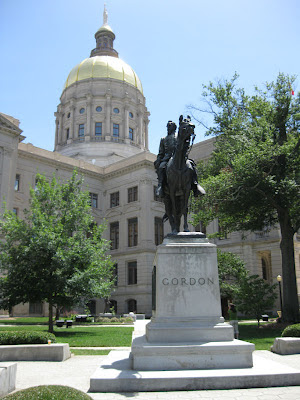
State Capitol
Outside the capitol are signs, placed by the Atlanta Chapter of the United Daughters of the Confederacy in 1920, describing the fall of Atlanta. General William Tecumseh Sherman's siege was a "reign of terror." His order to evacuate the city was "merciless." Sherman's taking of Atlanta and his subsequent March to the Sea are still controversial. I'm with Sherman on this one. The South started the war by firing the first shot at Fort Sumter. The war they thought would last a few weeks dragged on with no end in sight. Sherman saw that to speed the war's end and save lives in the long run, the infrastructure that supported the troops had to be destroyed. So Georgia howled and South Carolina got it even worse. But Sherman let up on North Carolina, which hadn't been as deep into secession as her sisters. In North Carolina Sherman and Johnston met again in battle. Johnston surrendered to Sherman, and the war soon came to a close.
CNN Center
I'm a Fox News guy myself, at least until Erin Burnett comes on.

Kennesaw Mountain National Battlefield Park
 |
| Kennesaw Mountain with Visitor Center and Cannon |
Here Sherman fought Johnston in the Atlanta Campaign. He could not prevail in direct attacks, so he outflanked the Confederates, and went on to take Atlanta. Kennesaw Mountain was designated a national battlefield in 1917.
At 1,808 feet, Kennesaw Mountain is the highest point in the core metropolitan Atlanta area. Its park setting and network of roads and paths attract many walkers and joggers. When I arrived around nine o'clock the main parking lot was already full, so I went to a secondary lot. The elevation gain from the Visitor Center to the summit is 657 feet, making for a pleasant 1.1 mile morning walk, but I took the shuttle bus as my time was limited. Kennesaw Mountain lacks the solitude and vistas of the Sierra Nevada. People were all about. On this overcast and hazy day I could not see across the flatlands to Atlanta.
Oakland Cemetery
Of the some 6,900 soldiers buried in the Confederate section of the cemetery, about 3,000 are unknown. Such was the horror of the Civil War. Sixteen Union soldiers were somehow interred in this section.


The grave site of Margaret Mitchell, author of Gone With the Wind, is popular with photographers.
 |
| Margaret Mitchell Grave Site |
I chanced upon the grave of a man drowned in the Chagres River of Panama at age twenty. I would guess that he worked on the canal construction, and drowned somewhere between Cruces and Chagres. A long stretch of the river for sure, most now under Gatun Lake.
Update: On the Internet I found his obituary, published in the Panama Canal Record:
Gordon Burton Smith, of Atlanta, Ga., a civil engineer in the employ of the Panama railroad, was drowned in the Chagres River near Gamboa bridge on the afternoon of August 20. He was crossing the river in a native canoe which was swamped. Two laborers who were in the boat with him escaped. Mr. Smith came to the Isthmus on January 30, 1908, and was employed in the Pacific Division until January 18, 1909, when he transferred to the relocation of the Panama railroad. He was 20 years of age. The body was recovered near San Pablo shortly after midnight Sunday, and was shipped to Atlanta, Tuesday, August 24.
Elsewhere:
A Card of Thanks. As friends of the late Gordon Burton Smith, and on behalf of his family, we wish to thank all those who assisted in the search for his body, from the time of his drowning in the Chagres River at Gamboa, on August 20, until the body was recovered at San Pablo on the night of August 22. Louis E. Wilcox, A. R. James. Corozal, August 23, 1909.

Martin Luther King, Jr. National Historic Site
I grew up near Oakland, California, birthplace of the Black Panther Party, which chanted "Off the pig!" Thank God Martin Luther King's call for non-violence as a response to centuries of oppression prevailed.


Outside the capitol are signs, placed by the Atlanta Chapter of the United Daughters of the Confederacy in 1920, describing the fall of Atlanta. General William Tecumseh Sherman's siege was a "reign of terror." His order to evacuate the city was "merciless." Sherman's taking of Atlanta and his subsequent March to the Sea are still controversial. I'm with Sherman on this one. The South started the war by firing the first shot at Fort Sumter. The war they thought would last a few weeks dragged on with no end in sight. Sherman saw that to speed the war's end and save lives in the long run, the infrastructure that supported the troops had to be destroyed. So Georgia howled and South Carolina got it even worse. But Sherman let up on North Carolina, which hadn't been as deep into secession as her sisters. In North Carolina Sherman and Johnston met again in battle. Johnston surrendered to Sherman, and the war soon came to a close.

CNN Center
I'm a Fox News guy myself, at least until Erin Burnett comes on.

 |
| Erin. Erin. Erin. |
Thursday, July 19, 2012
No Hands Bridge
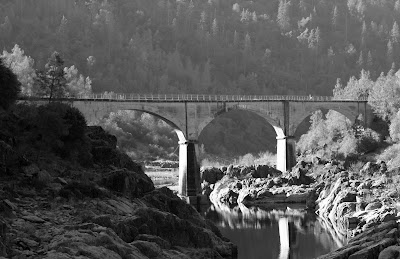
No Hands Bridge is just downriver from the Confluence of the North Fork and the Middle Fork of the American River. (Not to be confused with the North Fork of the Middle Fork of the American River in previous posts.) The story goes that, after the Mountain Quarries Railroad abandoned the bridge and before guardrails were installed, there was a horse rider who would cross the bridge without holding the reins.
The drop to the river is 150 feet.
Here's a pencil drawing I did of the bridge:

Here's a photo of it:
The drop to the river is 150 feet.
Here's a pencil drawing I did of the bridge:

Here's a photo of it:

Saturday, June 30, 2012
Hike to Tinker Knob
 |
| The crest of the Sierra, view south to Anderson Peak |
Today I hiked a small section of the Pacific Crest Trail, some seven miles from Donner Pass to Tinker Knob. The Trail extends 2,650 miles from the border of Mexico to the border of Canada. The Pacific Crest Trail Association says that an average of 300 hikers attempt the entire route each year. (And about 180 finish.) I spoke with six of them. The first two were in their late twenties or early thirties. The man was from Norway and the woman was from Wisconsin. I don't know if they were a couple or had informally joined up. The hikers start at Campo, California, either alone or in groups, and along the way they form informal partnerships, to share information and to check on each other's welfare. Since there is a window of time to do the hike, the hikers depart in April, and the wave of hikers was now passing through this area. The next man I met was in his late twenties. He was from Houston and worked in home remodeling, but with a shortage of work he was taking these several months to hike the trail. I met the other three hikers on my return from Tinker Knob. They were walking at a pace far faster than mine and they overtook me. They were less talkative than the others, but I learned that the couple was from England and the other hiker was from Palm Springs. The man was in his early twenties and the couple was in their late twenties. To hike the entire trail, one must be in top physical shape, and being young is a plus.
I saw a total of about thirty people on the trail. There were groups of runners. They park a vehicle at the Squaw Valley Ski Resort, drive to Donner Summit, and then run the trail (average elevation around 8,000 feet) to Squaw Valley. Others, like me, were out for a simple day hike.
I stopped at Roller Pass to look down the slope. The overland emigrants, after crossing prairies and deserts, noted in their diaries the dread they felt upon reaching their greatest obstacle, the wall of the Sierra Nevada. Roller Pass saw use from 1847 to 1850. It was less arduous than the Donner Pass crossing to north, where wagons had to be disassembled before being hoisted up the cliffs. With a 400 foot chain set over a log (the roller), the emigrants used double teams of oxen to bring their wagons up the slope. Once at the top, it was pretty much all downhill (but still a difficult journey) to the Sacramento Valley. The interpretive sign at Roller Pass stated that a little under 10,000 emigrants used this route.
 |
| View north to Roller Pass, Mount Judah in the background |
I continued my hike south to Tinker Knob. There were still large patches of snow blocking sections of the trail. One simply walks around them.

Tinker Knob is the core of a long dead volcano. The summit (8,949 feet) is reached by a bit of scrambling - there is no defined trail. The slope is steep and one must pay attention. Once at the top, the scenery is magnificent. Tucked amongst some rocks is a military ammo can with log books. I read my July 19, 2009 (10:52 AM) entry where I mentioned my bear encounter down by the ski lifts. I logged myself in for this hike. Another hiker reached the summit and we talked for some ten minutes. He then departed, to return to Donner Summit. I took some more photographs, gathered my gear, and left. Going down the slope of Tinker Knob takes more caution than going up.
 |
| Tinker Knob, 1.2 miles away, seen from Anderson Peak |
The only thing of note on the return hike was the wind, the steady relentless west wind blasting over the crest. But, in all, a nice hike for this day.
Tuesday, June 26, 2012
Early Summer Early Evening Foothills Walk
The summer solstice passed but a few days ago and the days are slowly getting shorter, but there is plenty of light after the workday ends to get some nice walks in the foothills around Auburn. And the angle of the sunlight on the hillsides provides some good photographs.
Here are some photos taken today along Stagecoach Trail, part of a toll road built in the 1850s to connect the county seat of Auburn and the mining town of Iowa Hill.
Unfortunately on this walk, the sunlight did not allow for a good photograph of a particular outcrop of metavolcanic rocks. (I'll get a photo later.) The folding and twisting of these rocks attest to the incredible subduction forces that created these parts. The rocks began as oceanic volcanoes hundreds of miles to the west, and were jammed into place here in the Jurassic Period, some 145 to 199 million years ago.
Or, if you take a fundamentalist view of things, just a few thousand years ago.


Update: I returned to Stagecoach Trail to get photos of the outcrop of metavolcanic rocks. Here's the outcrop from a distance.

And here are closer views.


Here are some photos taken today along Stagecoach Trail, part of a toll road built in the 1850s to connect the county seat of Auburn and the mining town of Iowa Hill.
Unfortunately on this walk, the sunlight did not allow for a good photograph of a particular outcrop of metavolcanic rocks. (I'll get a photo later.) The folding and twisting of these rocks attest to the incredible subduction forces that created these parts. The rocks began as oceanic volcanoes hundreds of miles to the west, and were jammed into place here in the Jurassic Period, some 145 to 199 million years ago.
Or, if you take a fundamentalist view of things, just a few thousand years ago.


_______________________________________________________________
Update: I returned to Stagecoach Trail to get photos of the outcrop of metavolcanic rocks. Here's the outcrop from a distance.

And here are closer views.


Monday, June 4, 2012
Panama 2012 - Piedra Pintada
Be sure to hire a guide to take you to the pre-Colombian petroglyphs at Piedra Pintada. This site is nestled in El Valle de Anton, the floor of an ancient volcanic caldera about a two-hour drive west of Panama City. You can choose from among the several Indian kids waiting at the entrance. The remaining kids will watch your vehicle and "make sure" it "stays safe". Cheap insurance for about two dollars. The uphill walk takes some five minutes, and the air is cool at this high altitude. At the site, your guide will tell you what the many carvings on the massive block of rock represent. The designs have baffled archaeologists, but the guide will say this is a lake, this is a waterfall, etc. While the meanings may be fabricated, what can't be denied is that the young guide gives a heck of a presentation.
Here is the video link.

 |
| Petroglyphs at Piedra Pintada |
Be sure to hire a guide to take you to the pre-Colombian petroglyphs at Piedra Pintada. This site is nestled in El Valle de Anton, the floor of an ancient volcanic caldera about a two-hour drive west of Panama City. You can choose from among the several Indian kids waiting at the entrance. The remaining kids will watch your vehicle and "make sure" it "stays safe". Cheap insurance for about two dollars. The uphill walk takes some five minutes, and the air is cool at this high altitude. At the site, your guide will tell you what the many carvings on the massive block of rock represent. The designs have baffled archaeologists, but the guide will say this is a lake, this is a waterfall, etc. While the meanings may be fabricated, what can't be denied is that the young guide gives a heck of a presentation.
Here is the video link.
 |
| Our guide |

Subscribe to:
Comments (Atom)