Off Auburn Folsom Road in Granite Bay is a small nature preserve that runs along Miners Ravine. The ravine got its name when miners worked its gravels for gold. Today I returned to the preserve, my last visit being many years ago. A half mile loop trail passes a granite outcrop with bedrock mortars where Nisenan women over many centuries ground acorns into meal. Granite forms deep underground. A mountaintop was several miles above here some 128 million years ago. The mountain wore away and filled part of the Sacramento Valley. Now the outcrop is at the base of the relatively young and still-rising Sierra Nevada.
My walk took me to an old oak tree. It stood proud when I last saw it, but since then disease and maybe high winds caused considerable damage.
The oak tree, October 24, 2004
The oak tree, January 21, 2017
Just a side note. The 2004 photograph was taken with slide film. I shot my last roll of slide film in November 2010. The one roll of Velvia slide film in my refrigerator may never be used. Last year I ordered chemicals to process some black and white film, dusted off the darkroom equipment, and made a few prints. It was a lot of money and time for those few prints. Film may never go away but it is not coming back.
Today's inauguration of Donald Trump as the 45th president of the United States does not herald a new order of the ages. That new order began with the founding of our country. Trump's presidency will get us closer to the principles of that new order - the people have the power, and America's interests come first. Much work awaits us.
Looking for something to raise our spirits what with all the recent dreadful weather, my wife and I went to the annual Day of the Dead celebration in downtown Sacramento. Normally this is held outdoors but the rains forced it into a parking garage. Still, there were crowds aplenty. This is a Mexican cultural event and most attendees were of Mexican heritage. The Mexican Consulate in Sacramento had a booth. Many of the Anglo visitors were of the liberal persuasion, judging by the serene look on their faces that screamed "Oh! All this multiculturalism!" One white man wore a tee shirt denouncing racism, while being surrounded by folks who identify as La Raza - The Race. Wearing a Trump Make America Great Again cap here would have been foolhardy at best. Taxpayer dollars were being spent having young people in khaki AmeriCorps uniforms help with the event, showing folks how to paint small skulls, that kind of stuff. How sad it is that these youngsters will leave AmeriCorps thinking they engaged in useful work. Better had they spent their time unloading trucks at the receiving dock of a major retail store, to get a taste of what real world work is like. The parking meter was running and I can't be frivolous on things such as personal fun when the government needs my money to give to others. So my wife and I left the parking garage and walked to our car, the sound of mariachi music fading in the distance.
Today I hiked Euchre Bar Trail, my goal the Southern Cross Mine, but when I reached the third downed tree, I decided to turn around.
No other vehicles were at the Iron Point trailhead when I arrived at 8:15. The clear skies and cool temperatures promised perfect hiking weather. In my Osprey pack were a fleece jacket, knit cap, and fire making items, to keep me through a chilly night in the deep canyon should circumstances dictate - a twisted ankle or being half-eaten by a mountain lion or such. I've never encountered another hiker beyond the bridge, and didn't expect to see one today. I wound down the steep trail. A westbound Union Pacific freight train some one thousand feet above me broke the silence. Soon I could hear the roar of the river. I reached the footbridge over the North Fork American River. There was no wind, and the surface of the water was like glass.
Iron Point Trailhead
Some twenty minutes after crossing the river, I reached a downed pine tree with a trunk diameter of about thirty inches. The needles were still green. The roots, now reaching into the air, had taken up large chunks of slate. The slate is part of the Shoo Fly complex, the oldest rocks of the Sierra Nevada, and in the slate can be found veins of quartz containing gold. I looked for quartz in this exposed slate, but saw none. I wound around the roots, crawled over the trunk, and continued on my hike.
I reached the second fallen tree, which I had seen on my last hike here (2014, I think). The bark had fallen off the trunk. I crawled over the trunk and continued on.
This section of trail is very beautiful, with the several emerald-green pools below. I passed a pile of stones at a level spot overlooking the river. I'm sure the Forty Niners put up these stones for a cabin or tent site during the Gold Rush. About the ground are chunks of quartz the miners pulled out of the hillsides. The rocks are now covered in moss.
A bit later I reached the third downed tree, too large to crawl over. Others had made a path up and over the roots. I looked at this obstacle and considered my situation. I was by myself, the mine was a good half mile away, and there might be more downed trees. If I needed to reach the mine, I could try the route from Foresthill Divide through Dorer Ranch. I considered everything, and decided to have lunch at my gold panning spot.
View from the trail to my gold panning spot
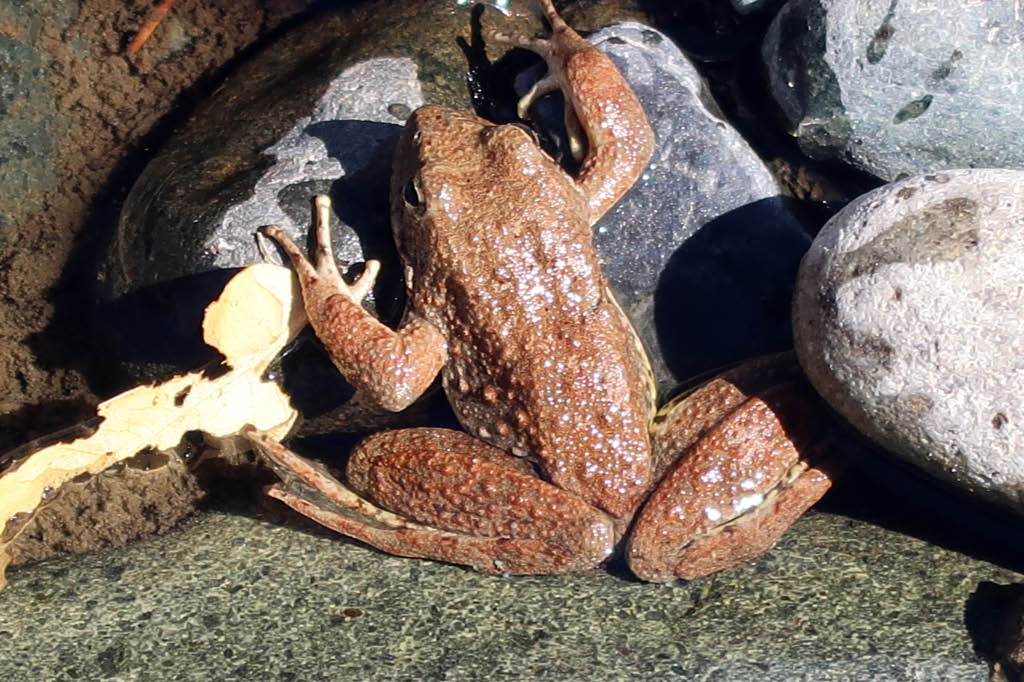
The river was at the lowest level I had ever seen, a good two feet below normal judging from the moss on the rocks. I'll return soon with a bucket, shovel, and gold pan, but today I simply enjoyed the scenery. Small trout rose to the surface. Frogs hopped about. During spring snow melts, in years without drought, I've seen the river running so hard that getting caught in the current meant certain death, and I've heard the clunk of boulders the size of basketballs moving downstream. But today I could have crossed the river without getting my knees wet. I finished my lunch and poked around the bar. People camp here. Someone had left behind a piece of quartz taken from a nearby vein. I'm sure they had taken several pieces, but left this one as it contained so little gold it was not worth carrying out of the canyon. I left the rock, so that others could find it and see the gold. Also at the bar was the rusted wheel of an ore cart from some mine around here.
Gold-bearing quartz
I wonder if this is where Thomas Lane met his end. From the Daily Alta California of July 2, 1855:
I made the 1800 foot ascent without needing to stop and rest. I did briefly talk with two men in their thirties hiking down to the river, the only others I saw on the trail this day. They didn't intend to go beyond the bridge. Few people do. Here may be the reason the trail from Iron Point to the river is well maintained, while the section from the river to Dorer Ranch is blocked with downed trees - it's a matter of use. Or maybe the Forest Service doesn't have the staffing or funds to remove those large trees. (The Forest Service website says that no trail maintenance has been done since 2013.) Perhaps it's intentional neglect. This is a designated Wild and Scenic River, and since few use the section of trail, why not let it revert to its wild state?
This board inside the Auburn Veterans Memorial Hall (built 1931, dedicated January 1932) tells us of the existence of Auburn Barracks 570, Veterans of World War I.
The Veterans of World War I of the U.S.A., Inc. was organized in 1948 and incorporated by Congress in 1958. It was a fraternal, civic, and social organization, with a constitution, by-laws, and rituals similar to those of the Grand Army of the Republic and the American Legion. The organization dissolved following the death in 2011 of its National Commander and last remaining member, Frank Woodruff Buckles, who was also the last surviving American veteran of World War I.
The board in Auburn has the first entry dated 1956. The last year with a Barracks Commander is 1986. The last year with an Auxiliary President (a veteran's wife) is 1989.